
HubNugget
Building an AI-Powered Hiring & Talent Platform
Preview
Case Study
HubNugget
Building an AI-Powered Recruitment Platform from the Ground Up
Role: Founder & Lead Product Engineer
Duration: Dec 2025 – Present
Tech Stack: Angular, NestJS, PostgreSQL, Redis, Docker, AI Integrations, TypeScript
Overview
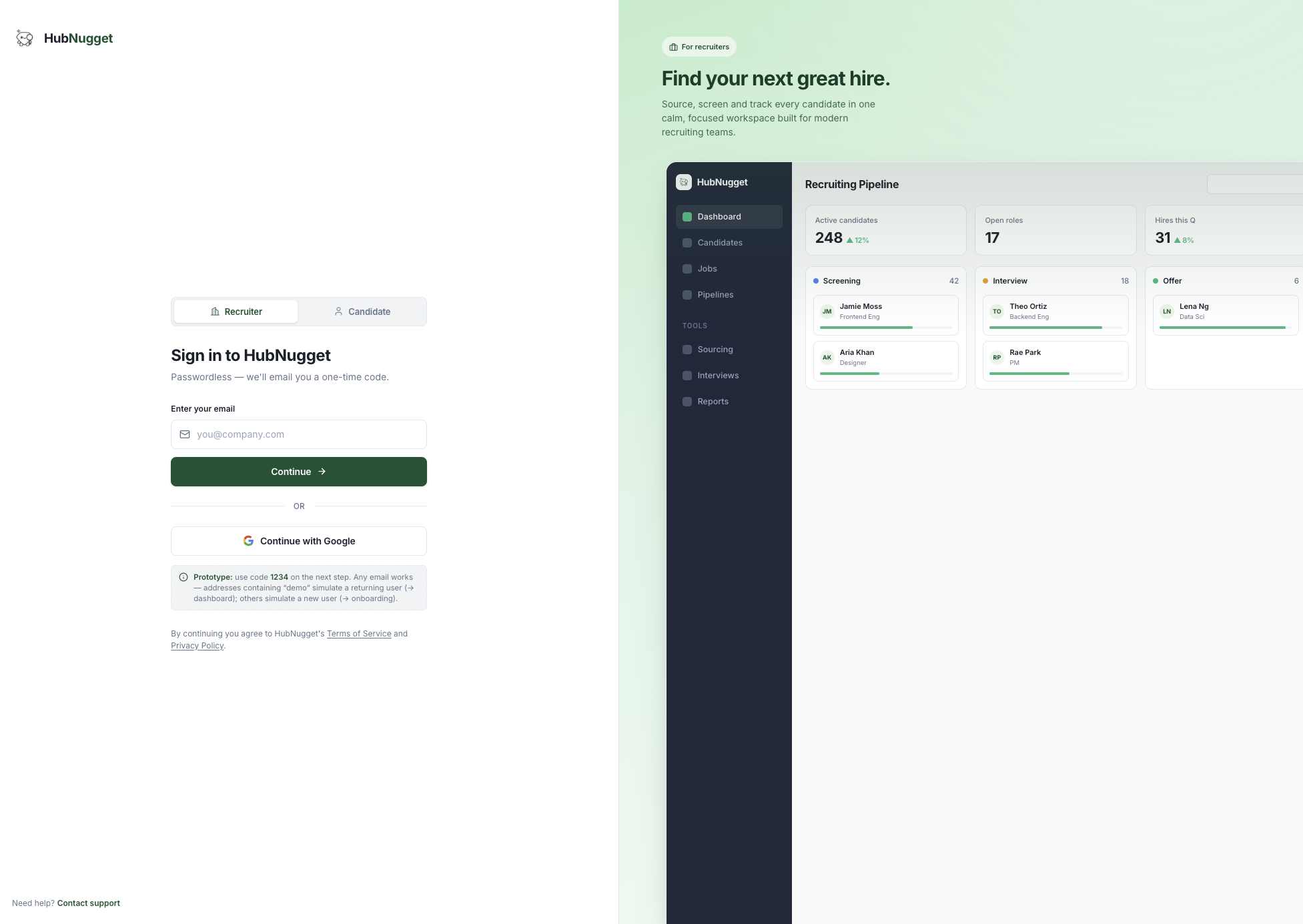
HubNugget is a modern recruitment platform designed to simplify hiring workflows for recruiters, staffing agencies, and growing businesses. The vision was to create a system that combines traditional Applicant Tracking System (ATS) capabilities with AI-powered automation and a candidate-centric experience.
Unlike many recruitment tools that focus solely on recruiters, HubNugget was designed to serve both sides of the hiring process by providing intelligent workflows, candidate portfolios, and automation capabilities.
The Problem
During years of working with startups, recruitment agencies, and growing businesses, I repeatedly observed the same challenges:
- Recruiters managing candidate information across multiple tools and spreadsheets.
- Hiring teams spending significant time on repetitive administrative tasks.
- Candidates struggling to showcase their experience beyond traditional resumes.
- Existing ATS platforms being either too complex, too expensive, or lacking modern user experiences.
The opportunity was to build a platform that felt modern, intuitive, and automation-ready from day one.
Key Features
Recruitment Workflow Management
Designed end-to-end recruitment workflows covering:
- Job creation and management.
- Candidate tracking.
- Pipeline management.
- Recruitment stages and status tracking.
- Team collaboration workflows.
Candidate Portfolio Experience
One of the core ideas behind HubNugget was enabling candidates to move beyond static resumes.
The platform explores AI-assisted portfolio generation, helping candidates create richer professional profiles and improve discoverability.
AI-Powered Enhancements
Areas explored and implemented include:
- Resume parsing.
- Candidate data extraction.
- AI-assisted profile generation.
- Workflow automation.
- Intelligent candidate insights.
Scalable Platform Foundation
The platform was designed with future growth in mind, focusing on:
- Modular architecture.
- API-first design.
- Scalable backend services.
- Cloud-friendly deployment patterns.
- Extensible feature modules.
Technical Challenges
Designing for Multiple User Types
The platform needed to support different user journeys:
- Recruiters
- Hiring Managers
- Candidates
- Administrators
Balancing these experiences while maintaining a clean product architecture was one of the biggest design challenges.
Building a Flexible Recruitment Engine
Recruitment workflows differ significantly between organizations.
The challenge was creating a pipeline system that could support multiple hiring processes without becoming overly complex.
AI Integration Strategy
Rather than adding AI as a marketing feature, the focus was on identifying practical use cases that reduced recruiter workload and improved candidate experiences.
Key Learnings
Building HubNugget strengthened my experience in:
- Product development and validation.
- Full-stack application architecture.
- Angular and NestJS ecosystem design.
- Authentication and authorization patterns.
- Scalable SaaS architecture.
- AI-assisted product development.
- User-centered workflow design.
- Technical decision-making under resource constraints.
Outcome
HubNugget continues to serve as both a product initiative and an engineering laboratory where new ideas around recruitment technology, AI workflows, system architecture, and developer productivity can be explored and validated.
The project represents my ability to take a product from concept to implementation while balancing product strategy, architecture, engineering execution, and long-term vision.
My Role
As the Founder and Lead Product Engineer, I was responsible for: * Product strategy and roadmap planning. * User experience and workflow design. * System architecture and technical decisions. * Frontend development using Angular. * Backend development using NestJS. * Database design and API architecture. * Authentication and authorisation systems. * Infrastructure and deployment strategy. * AI feature exploration and implementation. The project gave me the opportunity to operate across multiple disciplines, combining product thinking with hands-on engineering.