
EnKash
Scaling Frontend Architecture for a Growing Fintech Platform
Preview
Case Study
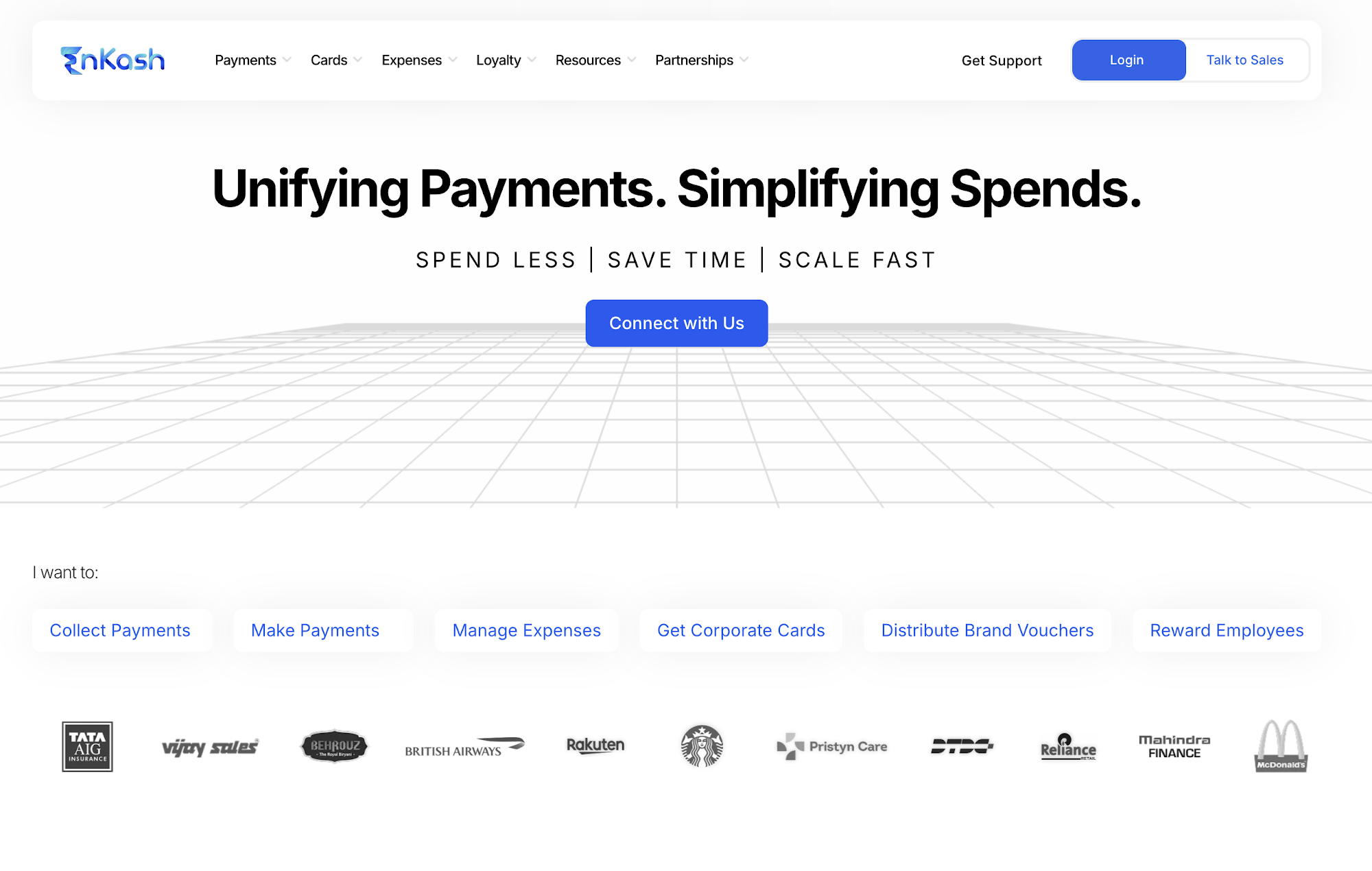
EnKash - Fintech Platform for Business Payments & Spend Management
Overview
EnKash is a fintech platform that helps businesses manage expenses, vendor payments, invoicing, cash flow, banking operations, and corporate spending.
I joined the company as a Senior Software Engineer and Frontend Lead during a period of rapid growth. My role extended beyond feature development and involved frontend leadership, product collaboration, architecture decisions, and helping the team deliver a modern user experience across multiple business-critical products.
During my time at EnKash, I worked closely with founders, product managers, designers, and engineers to build features that supported the company's growth and contributed to its product maturity during its funding journey.
The Challenge
EnKash was growing rapidly and expanding its product offerings across multiple financial workflows.
The platform needed to support:
- Expense management
- Spend management
- Vendor payments
- Invoicing
- Cash flow management
- Banking integrations
- Analytics and reporting
- Authentication and security
As the product expanded, maintaining consistency across multiple applications and teams became increasingly important.
The engineering team also needed a scalable frontend architecture capable of supporting independent development across different product modules.
The Solution
My focus was on building scalable frontend systems while improving the overall user experience of the platform.
I worked closely with product and design teams to translate business requirements into production-ready solutions and establish engineering practices that improved maintainability and delivery speed.
This included:
- Building reusable Angular components and modules.
- Leading frontend implementation efforts.
- Improving application architecture.
- Supporting large-scale product redesign initiatives.
- Introducing micro-frontend architecture using Single SPA.
- Integrating multiple internal and external business systems.
Key Contributions
Product Redesign
One of my most significant contributions was helping redesign the platform experience across both the public website and core product applications.
The redesign focused on improving usability, consistency, and user experience while supporting the company's evolving business goals.
This work was recognized internally and contributed to receiving the company's Best Employee award.
Authentication & Security
Implemented and enhanced security-related workflows including:
- Multi-Factor Authentication (MFA)
- Single Sign-On (SSO)
- Authentication workflows across multiple applications
Business-Critical Features
Built and enhanced multiple modules including:
- Expense Management
- Spend Management
- Vendor Management
- Invoicing
- Cash Flow Management
- Analytics & Reporting
Third-Party Integrations
Integrated multiple business systems and external services, including:
- Banking integrations
- Accounting and reconciliation workflows
- Tally integration
- Payment-related services
- Corporate card and spending workflows
Technical Challenges
Micro-Frontend Adoption
The platform contained applications built using different technologies, including Angular, React, and legacy JavaScript modules.
To support independent deployments and future scalability, I helped introduce a micro-frontend architecture using Single SPA.
One challenge was enabling seamless authentication across multiple applications while maintaining a unified user experience.
To address this, I implemented shared authentication mechanisms and application communication strategies that allowed users to move between modules without repeated sign-ins.
Cross-Team Collaboration
Product requirements often involved multiple stakeholders, including founders, product managers, designers, and engineering teams.
Balancing business goals with technical feasibility required constant collaboration and communication.
Scaling Product Complexity
As the platform expanded, maintaining consistency across dozens of workflows and business processes became increasingly important.
Reusable component design and architectural consistency helped reduce duplication and improve maintainability.
Technologies Used
- Angular
- TypeScript
- Single SPA
- Micro Frontends
- REST APIs
- Authentication Systems
- SSO
- MFA
- Fintech Integrations
Outcome
During my time at EnKash, I helped evolve the frontend architecture, improve product usability, and deliver several business-critical features across the platform.
The introduction of micro-frontend architecture, implementation of key financial workflows, and product redesign initiatives helped create a stronger foundation for future growth.
Beyond technical contributions, the experience strengthened my skills in product thinking, engineering leadership, stakeholder communication, and building software that supports real business operations at scale.
My Role
As Frontend Lead, I was responsible for: Leading frontend engineering initiatives. Collaborating with founders on product requirements and technical decisions. Working closely with design teams to improve UX and usability. Mentoring engineers and reviewing implementation approaches. Building core product features and reusable components. Driving frontend architectural improvements. I also contributed to hiring activities, engineering discussions, and long-term product planning.